


Types of social networks
Social media has become part of our daily routine—like morning coffee or checking the news. They bring people together, inspire, and help build a digital footprint. For some, these platforms are a means of communication, while for others, they’re a tool for brand promotion or job searching.
From this article you will learn, what are social networks?, how they were created and developed, and the main types—from communications to professional and niche. This overview will help you better understand how the modern digital world works and how to effectively utilize its capabilities.
What are social networks and how did they develop
Social networks are online platforms that allow users to create personal profiles, share information, communicate, and build connections with others. Simply put, they are digital spaces for interaction where people become not just consumers of content, but also active creators. Modern social networks— it’s no longer just a place to socialize. They’ve become global media platforms, where ideas are born, opinions are formed, and new cultural trends are born.
Understanding the specifics of each platform helps you consciously choose the right interaction channels and use them most effectively. The first attempts to create social networks appeared in the late 1990s. SixDegrees, where users could create profiles and add friends, is considered one of the precursors of modern platforms. MySpace and LiveJournal then developed, becoming a place for self-expression, blogging, and the first online communities.
However, the real breakthrough came in 2004, when Facebook set the standard for modern online interaction. Today, there are a variety of formats and trends—from visual platforms like Instagram and TikTok to professional platforms like LinkedIn.
Main types of social networks
To understand, what social networks are there?To understand how they differ, it’s worth considering their main categories. Dividing them into types helps us understand how different platforms meet specific needs.
Generally types of social networks can be classified by functionality and purpose of use. Some platforms are focused on communication and news, others on visual content, self-expression, and creativity, and still others on professional contacts and career development. A separate group consists of thematic and niche platforms – social platforms, uniting people with common interests.
Communication networks
Communication social networks, or relationship networks, are designed to maintain contacts, exchange information, and interact between users. Their main function is communication in different formats, for example:
- personal messages;
- chats;
- interest groups;
- publications and comments.
These platforms bring people together regardless of geography and allow them to build both personal and professional connections.
Facebook — one of the most well-known communication networks in the world. Initially aimed at students, the platform quickly became accessible to everyone. Key features:
- personal profile with photos, videos and posts;
- news feeds with updates from friends and communities;
- interest groups, clubs and forums;
- pages for businesses and brands;
- events and activities, including online broadcasts.
Facebook allows users to build personal and professional connections, share information, and participate in discussions. The platform is actively integrated with other services and supports advertising and content promotion, making it important not only for communication but also for media and business.
Telegram combines the functions of a communications network and a media platform. It has become popular due to its high-speed messaging and data security. Key features:
- personal chats and group conversations;
- channels for news, educational content and public announcements;
- stickers, GIFs and multimedia messages;
- bots for task automation and audience interaction;
- secret chats.
Telegram is actively used both as a communication tool and as a platform for distributing information and promoting brands. It caters to a variety of users, from everyday people keeping in touch with friends to media and professional communities.
Another popular one social network—X it’s designed for exchanging short messages (tweets), known for its rapid news feeds and public discussions. Key features:
- publishing short texts, links, photos and videos;
- the ability to retweet and comment on messages;
- formation of microblogs and thematic discussions;
- subscriptions to users and channels of interest;
- Hashtags for searching and organizing content by topic.
X is used as a source of current news, a platform for discussion, and a tool for public exchange of opinions. Global trends are formed here, and social and cultural campaigns are launched. Brands often use X for direct communication with their audiences.
Visual and creative platforms
Visual social networks focus on content perceived through images, video, and creative expression. They have become a space for inspiration, where emotions are expressed through frames, colour, and movement. These social networks are not just about likes, but also about creating an aesthetic through which people express themselves.
A striking example of visual platforms can be called Instagram, the service launched in 2010 as a photo-sharing app, but over time has evolved into a full-fledged media ecosystem. Key features:
- publishing photos and videos with filters and captions;
- stories — temporary publications;
- reels are short videos similar to TikTok;
- live broadcasts and joint broadcasts;
- Stores and brand showcases for e-commerce.
Instagram has become a powerful tool for personal branding and marketing. It promotes products, builds communities, and influencers shape trends. Through its visual presentation, Instagram combines elements of communication, inspiration, and commerce.
TikTok has become one of the main symbols of the digital age social network, based on short videos. The app was launched in 2016 by the Chinese company ByteDance and quickly gained a global audience. Key features:
- creation and editing of short videos (from 15 seconds to several minutes);
- a huge library of sounds and effects;
- an algorithmic recommendation feed where content is selected individually;
- interactive challenges and hashtags;
- opportunities for live broadcasts and collaborations.
TikTok has become more than just an entertainment platform, but a place where new music hits, fashion trends, and even political movements are born. Here, the focus isn’t on professionalism, but on sincerity and creativity, making the network particularly attractive to young people and content creators.
Art-Marks also deserves special attention. It’s a social platform for creative professionals, artists, and brands, where visual content becomes a tool for self-expression and professional growth. Unlike mainstream platforms, Art-Marks emphasizes quality interaction, support for creators, and a conscious approach to publishing.
Professional and business networks
These social networks bring together people based on their fields of activity, experience, and business interests. Their primary goal is to create and develop professional connections, share knowledge, and identify opportunities for career advancement. Unlike entertainment platforms, these platforms focus on the skills and expertise of their users.
The largest professional social platform in the world – LinkedIn launched in 2003, LinkedIn today connects hundreds of millions of professionals across various industries. Here, users create not just profiles, but digital resumes showcasing their skills, achievements, experience, and recommendations. LinkedIn’s key features include:
- creating a professional profile and network of contacts;
- job search and vacancy posting;
- publication of expert articles and analysis;
- participation in professional communities and discussions;
- use of employer branding tools.
LinkedIn is actively used by companies: recruiters search for specialists, brands share news, and experts develop their personal image. The platform fosters a culture of open professional interaction, where the quality of dialogue and level of expertise are more important than the number of followers.
Niche and thematic social networks
Niche social networks are online platforms that bring together users based on specific interests, professions, or hobbies. Unlike general-purpose platforms, they foster more cohesive communities where participants exchange experiences, share their work, and support each other. These platforms often become full-fledged professional ecosystems for development within a specific field.
There are many niche social networks, some of them:
- Behance. A platform for designers, illustrators, photographers, and motion graphic artists. Owned by Adobe, the platform serves as a digital portfolio for creative professionals.
- ResearchGate. A network for scientists and researchers. It unites the academic community, allowing them to publish discoveries, share knowledge, and find collaborators.
- GitHub. Social network for software developers. Its members share source code, create collaborative projects, and help each other solve technical problems.
These platforms create opportunities for professional growth and collaboration. They help professionals find partners, share experiences, and present their achievements to a global audience.
Future Trends and Challenges for Social Media
Social media is evolving rapidly: they’ve moved beyond simple communication channels and have transformed into multifunctional ecosystems, from marketplaces to educational platforms. But with these growing capabilities comes a growing number of challenges related to trust, security, and content quality. Key development trends:
- Platform intelligence. Artificial intelligence is increasingly creating personalized feeds, helping create content, and analysing user behaviour.
- Emphasis on privacy. Users are increasingly choosing networks where they have control over their data.
- Integrating commerce and creativity. Social platforms are becoming showcases for not only publishing but also selling—especially on Instagram, TikTok, and Art-Marks.
- Formation of micro-communities. Instead of mass-market platforms, niche social networks are gaining popularity, where the quality of connection is more important than the number of followers.
Beyond the development prospects, social media faces a number of serious challenges. Users are experiencing information overload, and it’s becoming increasingly difficult to filter quality content. Mass-market platforms continue to struggle with fake news, manipulation, and the spread of inaccurate information. Furthermore, new ethical issues related to algorithms, artificial intelligence, and privacy are emerging.
The future of social media depends on how harmoniously technology and human values can be combined. Those platforms that can preserve the meaning of communication, ensure data protection, and help users realize their potential will prevail.Platforms like Art-Marks LinkedIn and Telegram are already moving in this direction. They’re creating a space where communication becomes more than just messaging, but a source of growth, inspiration, and genuine mutual support.
It might also be interesting
See all



Marketing funnel: why businesses need it
In today’s business, when there are many tools to promote a product, marketing strategy becomes overgrown with details that are often difficult to link together. The sales funnel is a model of consumer interactions with a brand, from first encounter to repeat sales. It helps to understand what measures really bring results, where to improve the system and at what point potential customers are “lost”. However, it is only through a deep study of each stage that the full potential of this tool can be utilised.*** Translated with www.DeepL.com/Translator (free version) ***
What is a sales funnel and why to implement it
The marketing funnel allows you to visualise the “customer journey” not only in terms of one promotional channel, but of all interactions. This approach helps to track results at different stages and improve them. Valuable information that the model provides:
- the number of potential customers at each stage of interaction;
- conversion rate by stage – the percentage of people moving from one stage to another;
- “bottlenecks” in sales, where customers “drop out”;
- the effectiveness of each individual promotion channel and campaigns;
- which products, promotions or content are resonating;
- sales forecasting and growth potential based on current conversion rates;
- how many customers return and recommend the product to others;
- return on investment in advertising.
This data gives a clear picture of the customer journey, allows you to improve it and then already “lead” a potential customer with a pre-planned “route”.
The main stages of the marketing funnel
All modern interpretations of the sales funnel are based on the AIDA model, described by the pioneer of marketing – American advertiser Elias St. Elmo Lewis (Elias St. Elmo Lewis). Elias St. Elmo Lewis (Elias St. Elmo Lewis) in his publications in trade publications of the late XIX – early XX century. He was the first to formulate the sequence:
AIDA: Attention → Interest → Desire → Action
Today, marketers are also adding a fifth stage – loyalty. It has taken an important place in the sales funnel, because attracting new customers is much more expensive for a company than retaining them. So, what is the essence of each stage of interaction:
- Attention/awareness – determines the first contact, informs the audience about the existence of the brand.
- Interest/consideration – the company remains in the memory, and the user starts looking for more information about it.
- Desire – the visitor becomes a lead, a potential customer who already has an idea of how the brand can be useful to him.
- Conversion – the user performs the target action to which the funnel was leading, mainly a purchase.
- Loyalty – the customer makes repeat purchases, becomes loyal to the brand and recommends it to others.
Detailed marketing funnel proposed by the company Cooler Insights:
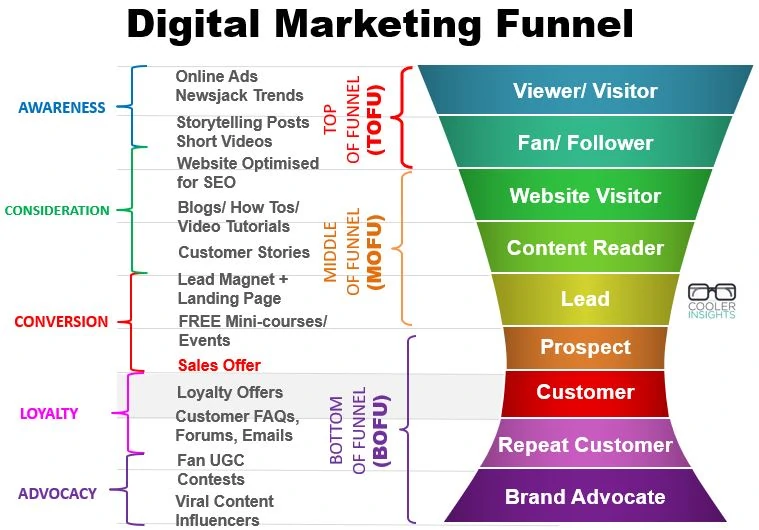
How to build a sales funnel
In a comprehensive set of statistics compiled by an independent publication for content makers Ecommerce Bonsai, Among other things, it says that 90 per cent of users are not ready to buy a product after visiting the site for the first time. Moreover, the consulting company EmailToolTester, has determined that the number of customer interactions can vary from 1 to 50 depending on the industry and audience. This is why a well-designed sales funnel becomes a priority for marketers. The basic steps of building one:
- Establish goals and key metrics.
- Define the target audience and map out the customer journey from brand awareness to purchase and retention.
- Create content and offers for each stage.
- Set up conversion points and connect tools (lendings, CRM, email).
- Track key metrics and customer behaviour.
- Automate communications and lead warming.
- Test and improve the funnel based on results.
A detailed sales funnel should include information on the stages of customer touchpoints, targeted actions, channels and tools to be used to motivate users.
Examples of building marketing funnels
Funnel for e-commerce
The e-commerce marketing funnel focuses on a quick buying cycle and maximising conversions on the website. The main goal is to engage the user, convince them of the value of the product and encourage them to buy, then retain them through loyalty programmes and repeat sales.
| Stage | Customer action | Channels | Instruments | Metrics / KPIs |
| Awareness | Sees an advert or social media post | Instagram, Facebook, Google Ads | Targeted advertising, banners | Reach, CTR, number of unique visitors |
| Interest | Reviews products, reads reviews | Website, email | Lead magnets, mailings, recommendations | Number of pages viewed, CTR, % of subscriptions |
| Consideration | Compares items, adds to basket | Website, email | Chat with a consultant, product comparison | Adds to basket, clicks on CTA, % engaged |
| Decision | Placing an order | Website | Shopping cart, coupons, remarketing | % of completed orders, average cheque, revenue |
| Retention | Repeat purchases, newsletter subscription | Email, social media | Loyalty programmes, promotions, recommendations | % of repeat purchases, LTV, NPSTV, NPS |
Funnel for B2B service
The B2B funnel is longer and more complex as decisions are made by a group of individuals and require ROI evaluation. The main focus is on building trust through content, demos, case studies and personal consultations. More information on what a B2B sales funnel is and its specifics can be found in this article HubSpot, a leading inbound marketing company.
| Stage | Customer action | Channels | Instruments | Metrics / KPIs |
| Awareness | Learns about the service, reads articles | LinkedIn, blog, email | SEO, content marketing, LinkedIn advertising | Traffic, blog views, CTR of adverts |
| Interest | Downloads a case study or a guide | Website, email | Lead magnet, email nurture-chain | Number of leads, subscriptions, CTR of emails |
| Consideration | Requests a demo or consultation | Website, phone call, email | Webinars, ROI calculator, consultations | Demo requests, % of conversion to MQL, engagement |
| Decision | Service subscription or contract | CRM, email | Special offers, tripwire, personalised offers | % of conversion to sale, CAC, average cheque |
| Retention | Subscription renewal, upsale | Email, account manager | Automation, drip campaigns, upsell | % renewal, LTV, NPS, number of recommendations |
Content marketing funnel
The sales funnel example for content marketing focuses on creating value and trust through useful content. The goal is to engage audiences, build brand expertise, and gradually warm users up to a subscription or purchase.
| Stage | Customer action | Channels | Instruments | Metrics / KPIs |
| Awareness | Finds an article or video | Blog, social media, YouTube | SEO, SMM, video, infographics | Traffic, views, CTR, reach |
| Interest | Reads/views the material, signs off | Email, blog | Email newsletters, free materials, webinars | Subscriptions, email CTR, average time on page |
| Consideration | Studies cases, evaluates the product | Website, email | Detailed guides, checklists, consultations | Downloads of materials, consultation requests, CTRs |
| Decision | Subscription to a paid course/product | Website, email | Tripwire, promotions, personalised offers | % of conversion to purchase, revenue, average cheque |
| Retention | Continues to use, shares content | Email, social media | New content, mailing list, community, recommendations | % of repeat subscribers, LTV, engagement, NPS |
Evaluating the results of sales funnel implementation
Once the sales funnel has been implemented, it is important to regularly evaluate its effectiveness and make adjustments. The main goal is to understand how well customers are converting at each stage, where losses occur, and which tools work best:
- Traffic and Reach – how many potential customers learnt about your product.
- Conversion by stage – the percentage of customers moving from Awareness to Interest, Consideration and Decision.
- CPL / CAC – the cost to attract a lead or customer.
- AOV (average cheque) and LTV – how much a customer brings in on average and how long they stay with you.
- NPS and Satisfaction – how satisfied customers are with the product and are willing to recommend you to others.
- Retention / repeat purchases – a measure of retention and engagement.
Regular analysis of these metrics allows you to identify bottlenecks in the funnel, improve content and offerers, as well as increase overall conversion and efficiency of advertising investments.As you can see, building a sales funnel is a complex and time-consuming process that requires not only a deep understanding of the industry and audience, but also marketing tools. Art-Marks team manages to build a client’s path with careful elaboration of stages and adaptation to the client’s business. This is possible thanks to the experience of co-operation with companies from different spheres and the comprehensive use of digital promotion channels.
*** Translated with www.DeepL.com/Translator (free version) ***
