

How to Identify Your Business’s Target Audience
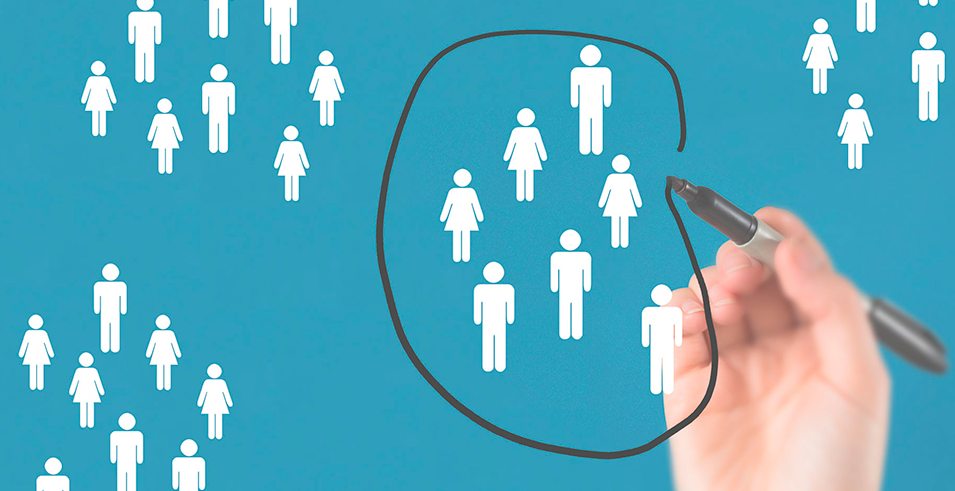
To effectively promote a product or service on the market, as well as to create a correctly working marketing strategy and increase sales, it is necessary to clearly understand who needs the product. The group of people, companies or organisations interested in the product and ready to buy it is called the target audience (TA). Its understanding helps to focus marketing efforts, increase their effectiveness and ensure the achievement of planned results. In this article, let’s look at how to determine the target audience and why it is necessary, with an emphasis on the benefits. Let’s consider effective techniques to fulfil the task at hand.
What is the target audience (TA)
Target audience in simple words is potential customers. A certain group of people or companies with common interests, characteristics, needs are interested in a particular product because they seek to use it to solve their problem or make a profit. To understand who my current customers are, I need to consider and analyse data:
- demographic – age, geographic location, gender, occupation, social status, income level, etc…;
- psychographic – values, interests, pain points, purchase incentives, expectations, financial spending behaviour, etc.
For example, visitors to a particular fitness studio or gym. This is the target audience, which includes men and women aged 20-50 who live in the same region. By buying a fitness gym membership, they fulfil their need to maintain a beautiful figure and excellent health.
Knowing the portrait of their ideal client, the business understands their wants and needs, and therefore can find or choose the best ways to meet them. Without knowing what the target audience is and understanding effective actions to identify it, branding and marketing do not bring the expected positive results. In such a situation, all the efforts of a company can be compared to trying to communicate in English with a person who speaks only Italian.
Why it is important to know your target audience
A clear understanding of which customers are being engaged with can play a crucial role in shaping plans and developing successful strategies. From this position, the target audience (CA) is a key driver of important company results. Knowing the customer portrait allows you to:
- Improve user experience and engagement. Personalised ads are more likely to hit the target – offering products and services to people who are definitely interested in them. For example, in relation to a career, location, or hobby. According to ZipDo Marketing Research Agency, about 65-70% of consumers are more willing to engage with brands that “understand” their needs.
- Increase satisfaction. In simple words, the business objective is to improve the relationship with the customer. The key point is that the target audience wants the perfect product. It is easier to improve a product or service when there is a clear idea of the end result. In fact, the work is “customised” for a certain group of people.
- Form effective marketing strategies. By regularly monitoring the results of work, correlating them with the needs of the CA, it is possible to make an optimal development plan even for a long-term period. According to Split Second Research, a marketing research agency, personalised advertising messages in email newsletters generate a 29% higher email open rate and 41% more clicks than conventional advertising.
- Develop a successful corporate identity. Resonance is important in any business and segment. Identifying the target audience allows you to create a corporate identity that matches its core values. In this case, resonance and subsequent attraction of new customers are guaranteed.
- Increase brand loyalty and your income level. A satisfied customer is the main goal of any company or business. A satisfied customer is very likely to remain loyal to a brand and recommend it to people he or she knows. According to the analytical agency Worldmetrics, a business that uses clear segmentation manages to achieve an increase in profit on individual advertising campaigns of up to 760%.
Identifying the target audience and working to meet their needs is the main factor in the success of any company or business. It is optimal to identify its nucleus and concentrate the main efforts on it. This is a group of customers who actively and easily make purchases, often make repeat orders and willingly tell other people about the brand.
Methods of target audience identification
There are quite a few ways to highlight or identify your target audience. Let’s focus on the main ones and consider them in more detail.
5W Methodology
Defining CA is pretty simple by answering 5 key questions:
- What? What am I offering the customers?
- Who? Basic information about the consumer interested in buying.
- Why? The reason for the purchase.
- When? The best time to make a purchase
- Where? Optimal points of contact with the consumer.
Comprehensive answers to the proposed questions provide a complete picture of the client’s portrait.
From the opposite
You will have to analyse the customer journey from the moment of the transaction to the first contact with the site, platform, seller. It is important to understand what their needs were and what motivated them to buy. Ads can be run for users with similar goals.
From the product
You should study your product or service in detail. It is important to look at it from different angles, to highlight its unique characteristics and advantages over competitors’ products. Based on the data obtained, calculate which customers the product will help to meet their needs or solve their problems.
From the market
The target audience with this method can be determined after in-depth analytical work. It is necessary to study the market and real reports on sales of specific products. Additionally, analyse the effectiveness of competitors working in this area. The collected information will help to make an accurate portrait of the client. However, mistakes made can seriously distort the results of work. To exclude such a negative scenario, it is optimal to apply for analytical services in reliable companies. The professional team of Art Marks advertising agency specialises in performing such tasks.
What is CA segmentation and why it is needed
Understanding how to define the target audience is important, but not the only aspect for the success of a company. After defining the customer portrait, it is necessary to perform segmentation of the target audience. This is the process of dividing potential customers (people, companies) into groups based on certain characteristics. The goal of such a process is to create personalised offers and connections, and as a result:
- increasing conversions;
- increasing the number of calls and applications;
- targeting potential customers;
- increased sales through targeted efforts.
An important point: segmentation is relevant for both start-ups and mature companies. The former are in search of their ideal niche. The latter are seeking to identify new points of growth and scaling their business.
Lack of segmentation increases the risk of pointless dissipation of marketing efforts and budgets. Without targeting customers, there is a high probability of directing advertising to people who are not interested in the product.
Tasks that are solved by CA segmentation
With the right approach to target audience segmentation or working with professional marketing companies, businesses can reap many benefits. Here are just a few of the key tasks that can be successfully managed:
- Improved personalisation. Personalised appeals in advertisements are more attractive to potential customers. For example, appealing by name, offering specific products that appeal to people of a certain age, gender, social status.
- Assortment optimisation. Understanding what the target audience is and working with your client is inextricably linked to the proper adaptation of the product catalogue. For example, you can form sections on the site of an online shop selling laptops: for study, for business, universal. If the company works with PCs of the budget and medium price segment, it is worth refusing to buy expensive gamer models.
- Increasing the effectiveness of advertising campaigns. A clear understanding of the interests, needs and problems of the CA allows you to create offers that will hit the target. This means you don’t have to set up adverts for all potential buyers, trying to guess what will interest them.
- Choosing the optimal channels of promotion. Platforms and resources on which you can place advertising, quite a lot. However, understanding which of them the target audience prefers allows you to refuse to work with dozens of tools, concentrating your efforts on 3-4.
- Cost reduction. Correct and timely segmentation of CA allows you to rationally manage the advertising budget. You can avoid unnecessary expenditure on testing and exclude “burning” of funds due to mistakes made when setting up the campaign.
After all, it is not necessarily necessary to work with the entire target audience. Thanks to its segmentation, you can get information about the most promising groups of potential customers. The so-called core of the CA. Then direct the main marketing efforts to them. This approach is ideal if you have a very limited advertising budget.
Specific examples of target audiences and actions to reach them
CA is always a group of people or companies that meet certain characteristics. However, when parameters are changed or expanded, its composition also changes. A few examples of target audiences will provide a better understanding of this marketing category:
- New parents. Men and women aged 20-50 years. They have recently become parents or are just preparing for this event. Their area of interest is child rearing and childcare. Relevant products and services: baby supplies, nutrition, development, teaching how to properly treat a daughter or son at different periods of her/his life.
- Technology enthusiasts. Enthusiasts who are eager to be the first to master a new gadget or a unique laptop. They are attracted to innovation. You can suggest buying an advanced flagship, an item for a smart home, original wearable devices.
- “Green” activists. Their interests are to minimise the negative impact on the planet. They focus on finding eco-friendly alternatives for different spheres of life. For example, renewable energy sources, organic food, waste-free products. In order to position your products correctly for this target audience, you need to emphasise their environmental friendliness.
Once you’ve identified your target audience, it’s important to ensure you reach them. A few standard steps will help you achieve your goal:
- Conduct market research. Use surveys, focus groups, online analytics tools to determine the preferences of potential customers.
- Choose the most effective marketing channels for promotion. Search advertising, social media, content marketing – anything that will help get the word out to consumers.
- Adapt your messaging. Personalisation works without fail. To enhance the effect, use visual materials, emphasise the advantages of the product.
Success in any field requires regular analysis of information and adaptation of marketing tools. It is not easy to cope with such a task without skills and relevant knowledge. Mistakes and misconfigured campaigns are fraught with unjustified expenses. The best solution for effective interaction with the target audience is to engage a team of professionals from the Art Marks advertising agency. More than 5 years of experience in working with projects of different levels of complexity. Dozens of successful cases for large and small businesses. Trust the professionals: at Art Marks we not only know how to identify the target audience, but also help you to use the information obtained to increase profits and scale your business.
Literature used:
- Fundamentals of marketing. A short course. /Kotler F.// -Williams 2020- pp.280-285, pp.318-396.
- Ogilvy on advertising. / Ogilvy D. // Mann, Ivanov & Ferber- 2017- p.195-218
- Ask the customer. How to use surveys to create a product that will hit the target accurately. /Ryan Levesque//- Mann, Ivanov & Ferber- 2019- p.120-152
- Fundamentals of marketing. /Kotler F., Armstrong G.//Williams 2020- pp.219-223, 411-427, 698-712.
It might also be interesting
See all



Marketing funnel: why businesses need it
In today’s business, when there are many tools to promote a product, marketing strategy becomes overgrown with details that are often difficult to link together. The sales funnel is a model of consumer interactions with a brand, from first encounter to repeat sales. It helps to understand what measures really bring results, where to improve the system and at what point potential customers are “lost”. However, it is only through a deep study of each stage that the full potential of this tool can be utilised.*** Translated with www.DeepL.com/Translator (free version) ***
What is a sales funnel and why to implement it
The marketing funnel allows you to visualise the “customer journey” not only in terms of one promotional channel, but of all interactions. This approach helps to track results at different stages and improve them. Valuable information that the model provides:
- the number of potential customers at each stage of interaction;
- conversion rate by stage – the percentage of people moving from one stage to another;
- “bottlenecks” in sales, where customers “drop out”;
- the effectiveness of each individual promotion channel and campaigns;
- which products, promotions or content are resonating;
- sales forecasting and growth potential based on current conversion rates;
- how many customers return and recommend the product to others;
- return on investment in advertising.
This data gives a clear picture of the customer journey, allows you to improve it and then already “lead” a potential customer with a pre-planned “route”.
The main stages of the marketing funnel
All modern interpretations of the sales funnel are based on the AIDA model, described by the pioneer of marketing – American advertiser Elias St. Elmo Lewis (Elias St. Elmo Lewis). Elias St. Elmo Lewis (Elias St. Elmo Lewis) in his publications in trade publications of the late XIX – early XX century. He was the first to formulate the sequence:
AIDA: Attention → Interest → Desire → Action
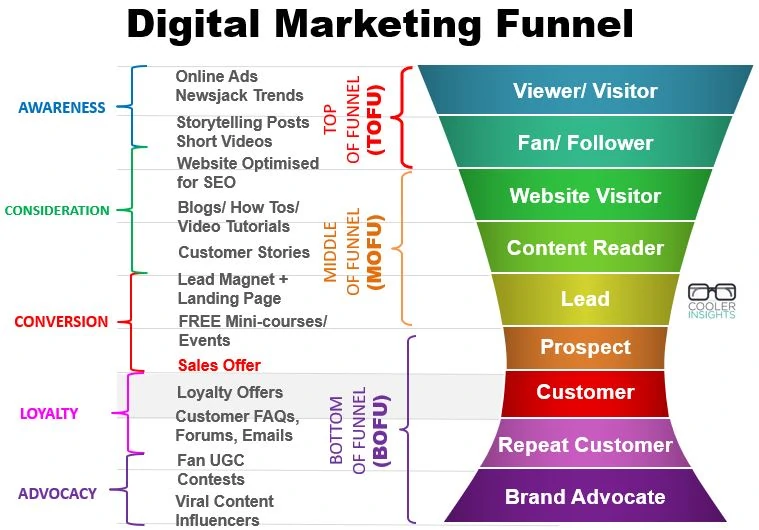
Today, marketers are also adding a fifth stage – loyalty. It has taken an important place in the sales funnel, because attracting new customers is much more expensive for a company than retaining them. So, what is the essence of each stage of interaction:
- Attention/awareness – determines the first contact, informs the audience about the existence of the brand.
- Interest/consideration – the company remains in the memory, and the user starts looking for more information about it.
- Desire – the visitor becomes a lead, a potential customer who already has an idea of how the brand can be useful to him.
- Conversion – the user performs the target action to which the funnel was leading, mainly a purchase.
- Loyalty – the customer makes repeat purchases, becomes loyal to the brand and recommends it to others.
Detailed marketing funnel proposed by the company Cooler Insights:
How to build a sales funnel
In a comprehensive set of statistics compiled by an independent publication for content makers Ecommerce Bonsai, Among other things, it says that 90 per cent of users are not ready to buy a product after visiting the site for the first time. Moreover, the consulting company EmailToolTester, has determined that the number of customer interactions can vary from 1 to 50 depending on the industry and audience. This is why a well-designed sales funnel becomes a priority for marketers. The basic steps of building one:
- Establish goals and key metrics.
- Define the target audience and map out the customer journey from brand awareness to purchase and retention.
- Create content and offers for each stage.
- Set up conversion points and connect tools (lendings, CRM, email).
- Track key metrics and customer behaviour.
- Automate communications and lead warming.
- Test and improve the funnel based on results.
A detailed sales funnel should include information on the stages of customer touchpoints, targeted actions, channels and tools to be used to motivate users.
Examples of building marketing funnels
Funnel for e-commerce
The e-commerce marketing funnel focuses on a quick buying cycle and maximising conversions on the website. The main goal is to engage the user, convince them of the value of the product and encourage them to buy, then retain them through loyalty programmes and repeat sales.
| Stage | Customer action | Channels | Instruments | Metrics / KPIs |
| Awareness | Sees an advert or social media post | Instagram, Facebook, Google Ads | Targeted advertising, banners | Reach, CTR, number of unique visitors |
| Interest | Reviews products, reads reviews | Website, email | Lead magnets, mailings, recommendations | Number of pages viewed, CTR, % of subscriptions |
| Consideration | Compares items, adds to basket | Website, email | Chat with a consultant, product comparison | Adds to basket, clicks on CTA, % engaged |
| Decision | Placing an order | Website | Shopping cart, coupons, remarketing | % of completed orders, average cheque, revenue |
| Retention | Repeat purchases, newsletter subscription | Email, social media | Loyalty programmes, promotions, recommendations | % of repeat purchases, LTV, NPSTV, NPS |
Funnel for B2B service
The B2B funnel is longer and more complex as decisions are made by a group of individuals and require ROI evaluation. The main focus is on building trust through content, demos, case studies and personal consultations. More information on what a B2B sales funnel is and its specifics can be found in this article HubSpot, a leading inbound marketing company.
| Stage | Customer action | Channels | Instruments | Metrics / KPIs |
| Awareness | Learns about the service, reads articles | LinkedIn, blog, email | SEO, content marketing, LinkedIn advertising | Traffic, blog views, CTR of adverts |
| Interest | Downloads a case study or a guide | Website, email | Lead magnet, email nurture-chain | Number of leads, subscriptions, CTR of emails |
| Consideration | Requests a demo or consultation | Website, phone call, email | Webinars, ROI calculator, consultations | Demo requests, % of conversion to MQL, engagement |
| Decision | Service subscription or contract | CRM, email | Special offers, tripwire, personalised offers | % of conversion to sale, CAC, average cheque |
| Retention | Subscription renewal, upsale | Email, account manager | Automation, drip campaigns, upsell | % renewal, LTV, NPS, number of recommendations |
Content marketing funnel
The sales funnel example for content marketing focuses on creating value and trust through useful content. The goal is to engage audiences, build brand expertise, and gradually warm users up to a subscription or purchase.
| Stage | Customer action | Channels | Instruments | Metrics / KPIs |
| Awareness | Finds an article or video | Blog, social media, YouTube | SEO, SMM, video, infographics | Traffic, views, CTR, reach |
| Interest | Reads/views the material, signs off | Email, blog | Email newsletters, free materials, webinars | Subscriptions, email CTR, average time on page |
| Consideration | Studies cases, evaluates the product | Website, email | Detailed guides, checklists, consultations | Downloads of materials, consultation requests, CTRs |
| Decision | Subscription to a paid course/product | Website, email | Tripwire, promotions, personalised offers | % of conversion to purchase, revenue, average cheque |
| Retention | Continues to use, shares content | Email, social media | New content, mailing list, community, recommendations | % of repeat subscribers, LTV, engagement, NPS |
Evaluating the results of sales funnel implementation
Once the sales funnel has been implemented, it is important to regularly evaluate its effectiveness and make adjustments. The main goal is to understand how well customers are converting at each stage, where losses occur, and which tools work best:
- Traffic and Reach – how many potential customers learnt about your product.
- Conversion by stage – the percentage of customers moving from Awareness to Interest, Consideration and Decision.
- CPL / CAC – the cost to attract a lead or customer.
- AOV (average cheque) and LTV – how much a customer brings in on average and how long they stay with you.
- NPS and Satisfaction – how satisfied customers are with the product and are willing to recommend you to others.
- Retention / repeat purchases – a measure of retention and engagement.
Regular analysis of these metrics allows you to identify bottlenecks in the funnel, improve content and offerers, as well as increase overall conversion and efficiency of advertising investments.As you can see, building a sales funnel is a complex and time-consuming process that requires not only a deep understanding of the industry and audience, but also marketing tools. Art-Marks team manages to build a client’s path with careful elaboration of stages and adaptation to the client’s business. This is possible thanks to the experience of co-operation with companies from different spheres and the comprehensive use of digital promotion channels.
*** Translated with www.DeepL.com/Translator (free version) ***
