


How to create an advertisement
Even the most successful and high-quality product won’t sell itself; it needs to be discovered by potential buyers. This is the role of advertising. Before creating a successful creative, it’s essential to conduct thorough audience research, find the right format, and select a key message that resonates with the potential client’s needs. How to make an advertisement a series of consistent actions will help you achieve a solution that will benefit your business and not drain your budget.
Why does business need advertising
First, it’s important to understand the role of creatives. Advertising isn’t just about increasing sales of a particular product. It helps build relationships with customers. Creatives determine how your brand is perceived by society. Effective advertising helps to achieve the following goals:
- creating associations with specific businesses;
- forming an emotional connection with the client;
- maintaining interest in the brand even during a decline in sales.
Creative marketing is essential for small businesses—it helps them go beyond word-of-mouth and scale. It’s also essential for established companies—advertising allows them to stay in front of customers and remind them why their brand is worth their attention.
In a world where competition between similar products is fierce, people buy not products but the experience they create. Advertising helps demonstrate what the customer will ultimately receive or experience.
Advertising Creation: Where to Start
In 2025, users of various gadgets will see up to 10 thousand advertisements furthermore, users are developing banner blindness—they’ve learned to ignore ads on websites and other online resources. This protects them from the overload of information literally pouring off their screens. Therefore, simply creating a catchy ad isn’t enough—it will quickly get lost in the vastness of the internet.
Before that how to create an advertisement, you need to do some in-depth research. Start by defining your goals. Here are some:
- search for new clients;
- increasing brand awareness;
- sale of a specific position.
Next, it’s worth analysing your competitors. You need to understand how you can stand out in the market. Based on this, you can create a unique selling proposition (USP). Explain to potential clients why they should choose you. The USP will become the foundation of your marketing strategy and will help you create advertising for business.
It’s important to understand your potential client—this will help you connect with their needs. Create a target audience profile—identify their gender, age, interests, location, and other details. For example, the target audience for a toy store is young parents, primarily mothers. A family may have one or two children. The store’s visitors are typically middle- or upper-income individuals, living in a city with a medium-sized population. It’s also worth understanding the platforms they spend most of their time on—this will help you determine where to place your ads. Consider the challenges your target audience faces—articulate their pain points or desires. Based on these, you can develop creative that will make the buyer think, “This describes me.”
At creating advertising from scratch, it’s important to consider your brand’s tone of voice. This is the voice of your company, which can be:
- warm and friendly;
- professional and expert;
- light and playful;
- inspiring and emotional;
- rational and businesslike.
Tone of voice determines the style of communication with potential clients—it will be reflected not only in advertising, but across all communication channels.
What is included in creative development
After conducting the analysis, you can begin developing the publication itself. To create an advertisement, you need to use:
- logic – explain why it is profitable to buy from you using facts and figures;
- psychology – understand what motivates a person to purchase a product;
- emotions – inspire confidence in a person, inspire him, use pleasant associations.
Tools such as fonts, composition, and colour palette can help with this. They can either attract attention or repel a brand. These tools help create a company’s image.
There’s no need to sound complicated—simplicity is your strength. Don’t try to say too much in a single ad. The customer might get overwhelmed by the information flow. To overcome banner blindness, your ad will require creativity.
Types of advertising for business
There are many different communication channels in email marketing. Before how to make an advertisement, it’s worth choosing the option that suits your needs and budget.
| Advertising format | Where does it work better? | Target | Example |
| Targeted (Facebook, Instagram, TikTok) | Local services, small and medium businesses | Attracting customers, increasing sales | Advertising a cafe for area residents |
| Contextual (Google Ads) | Online stores and popular services | Selling or generating leads | Buy a washing machine |
| Native | Blogs, media, social networks | Increasing brand trust | Blog article: “How to Choose a Mattress for Healthy Sleep” |
| Offline (billboards, radio, printed materials, exhibitions, etc.) | Local business, image campaigns | Increases brand awareness and presence | A developer’s billboard in the city |
| Video advertising | YouTube, social networks | Emotional connection, recognition | Brand video in Reels or Shorts |
| Email marketing | Online stores and services, educational projects | Increased loyalty, customer retention and repeat sales | Newsletter with a selection of new products, notifications about promotions and discounts for regular customers |
To improve campaign results, it’s worth testing both online and offline creatives. For example, you can combine social media targeting with billboards or printed materials.
Creatives that work for you
Create an advertisement special formulas will help. You can tailor your creativity to them. Here are some popular options.
AIDA – a timeless classic
The formula consists of the following stages:
- Attention – attract the user’s attention.
- Interest – warm up his interest.
- Desire – through benefit or emotion, awaken the desire to buy.
- Action — call to action.
AIDA is relevant for various communication methods. The formula is used in articles, videos, and newsletters.
4Ps – Preparing for Sales
This method was proposed by marketer and sales specialist Henry Hock. It consists of the following steps:
- Picture – show an ideal picture of the result the client can achieve.
- Promise – promise him a benefit.
- Proof — provide evidence in the form of reviews, figures, or case studies.
- Push – nudge someone to take the action you want.
The formula is effective for social networks, email newsletters, and videos.
Before-After-Bridge — from problem to solution
Another marketing technique for increasing sales. It uses the following steps:
- Before – show the problem the person is facing now.
- After – demonstrate how it can be solved.
- Bridge – visualize the path to the result using your product.
Identify your audience’s key pain points and offer a concrete solution. This formula is effective across various customer communication channels.
Advertising Mistakes: How to Avoid Wasting Your Budget
Creatives for promoting products and building relationships with audiences require investment. Unfortunately, they don’t always pay off. Even large companies sometimes make mistakes and waste their budget. However, you can protect yourself by ensuring your creative avoids common mistakes.
One of them is a lack of strategy. You need to think through every detail. In particular, make sure the creative aligns with the brand’s goals. Another problem is too much text. Formulate your messages clearly and concisely.
Beware of excessive creativity—it’s important that your audience isn’t simply entertained by the content, but that they pay attention to your product. When creating a publication, always keep your target audience in mind—tailor your content to their needs. Speak their language.
It’s important not only to launch a campaign, but also to analyse its results. It’s important to understand whether it’s helping the brand or simply wasting budget. Performance indicators, or KPIs, can help with this. These include ad clicks and their cost, return on investment, frequency, and audience reach. These and other metrics are available in your Google Ads dashboard.
When is the best time to seek help
Creating creative for a company is a complex task consisting of many stages. It’s important to choose a working strategy, define the audience, formulate a unique selling proposition, and more. At the beginning, it’s easier to handle this on your own. However, as the brand scales, difficulties can arise. After all, you need to oversee the running of the business and product development, and often there’s little time or energy left over for presentation.
Art-Marks can take on this task. Professionals will help you create a positive brand image, develop a working strategy, handle social media promotion, set up your Google Ads account, and track and optimize metrics. With them, you can focus on the product itself.
Advertising is an essential part of a company’s life and requires attention. It helps connect with potential customers and boost sales. With the right strategy, creatives won’t lead to unnecessary expenses, but will instead help your business grow and prosper.
It might also be interesting
See all





Marketing funnel: why businesses need it
In today’s business, when there are many tools to promote a product, marketing strategy becomes overgrown with details that are often difficult to link together. The sales funnel is a model of consumer interactions with a brand, from first encounter to repeat sales. It helps to understand what measures really bring results, where to improve the system and at what point potential customers are “lost”. However, it is only through a deep study of each stage that the full potential of this tool can be utilised.*** Translated with www.DeepL.com/Translator (free version) ***
What is a sales funnel and why to implement it
The marketing funnel allows you to visualise the “customer journey” not only in terms of one promotional channel, but of all interactions. This approach helps to track results at different stages and improve them. Valuable information that the model provides:
- the number of potential customers at each stage of interaction;
- conversion rate by stage – the percentage of people moving from one stage to another;
- “bottlenecks” in sales, where customers “drop out”;
- the effectiveness of each individual promotion channel and campaigns;
- which products, promotions or content are resonating;
- sales forecasting and growth potential based on current conversion rates;
- how many customers return and recommend the product to others;
- return on investment in advertising.
This data gives a clear picture of the customer journey, allows you to improve it and then already “lead” a potential customer with a pre-planned “route”.
The main stages of the marketing funnel
All modern interpretations of the sales funnel are based on the AIDA model, described by the pioneer of marketing – American advertiser Elias St. Elmo Lewis (Elias St. Elmo Lewis). Elias St. Elmo Lewis (Elias St. Elmo Lewis) in his publications in trade publications of the late XIX – early XX century. He was the first to formulate the sequence:
AIDA: Attention → Interest → Desire → Action
Today, marketers are also adding a fifth stage – loyalty. It has taken an important place in the sales funnel, because attracting new customers is much more expensive for a company than retaining them. So, what is the essence of each stage of interaction:
- Attention/awareness – determines the first contact, informs the audience about the existence of the brand.
- Interest/consideration – the company remains in the memory, and the user starts looking for more information about it.
- Desire – the visitor becomes a lead, a potential customer who already has an idea of how the brand can be useful to him.
- Conversion – the user performs the target action to which the funnel was leading, mainly a purchase.
- Loyalty – the customer makes repeat purchases, becomes loyal to the brand and recommends it to others.
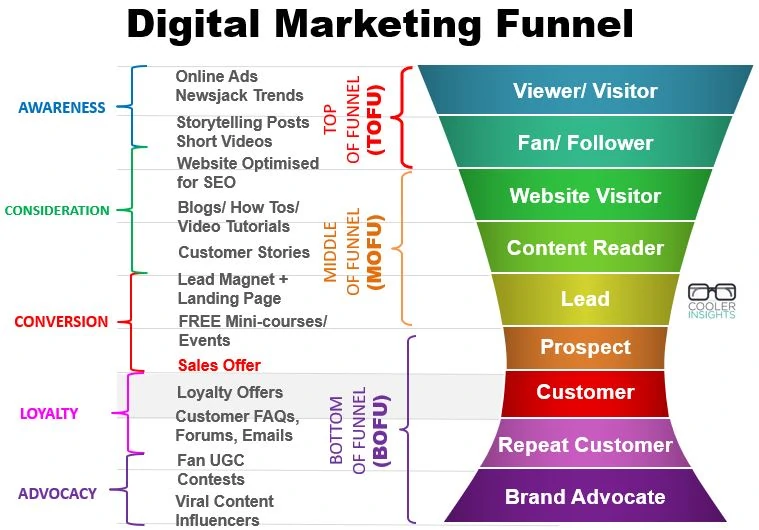
Detailed marketing funnel proposed by the company Cooler Insights:
How to build a sales funnel
In a comprehensive set of statistics compiled by an independent publication for content makers Ecommerce Bonsai, Among other things, it says that 90 per cent of users are not ready to buy a product after visiting the site for the first time. Moreover, the consulting company EmailToolTester, has determined that the number of customer interactions can vary from 1 to 50 depending on the industry and audience. This is why a well-designed sales funnel becomes a priority for marketers. The basic steps of building one:
- Establish goals and key metrics.
- Define the target audience and map out the customer journey from brand awareness to purchase and retention.
- Create content and offers for each stage.
- Set up conversion points and connect tools (lendings, CRM, email).
- Track key metrics and customer behaviour.
- Automate communications and lead warming.
- Test and improve the funnel based on results.
A detailed sales funnel should include information on the stages of customer touchpoints, targeted actions, channels and tools to be used to motivate users.
Examples of building marketing funnels
Funnel for e-commerce
The e-commerce marketing funnel focuses on a quick buying cycle and maximising conversions on the website. The main goal is to engage the user, convince them of the value of the product and encourage them to buy, then retain them through loyalty programmes and repeat sales.
| Stage | Customer action | Channels | Instruments | Metrics / KPIs |
| Awareness | Sees an advert or social media post | Instagram, Facebook, Google Ads | Targeted advertising, banners | Reach, CTR, number of unique visitors |
| Interest | Reviews products, reads reviews | Website, email | Lead magnets, mailings, recommendations | Number of pages viewed, CTR, % of subscriptions |
| Consideration | Compares items, adds to basket | Website, email | Chat with a consultant, product comparison | Adds to basket, clicks on CTA, % engaged |
| Decision | Placing an order | Website | Shopping cart, coupons, remarketing | % of completed orders, average cheque, revenue |
| Retention | Repeat purchases, newsletter subscription | Email, social media | Loyalty programmes, promotions, recommendations | % of repeat purchases, LTV, NPSTV, NPS |
Funnel for B2B service
The B2B funnel is longer and more complex as decisions are made by a group of individuals and require ROI evaluation. The main focus is on building trust through content, demos, case studies and personal consultations. More information on what a B2B sales funnel is and its specifics can be found in this article HubSpot, a leading inbound marketing company.
| Stage | Customer action | Channels | Instruments | Metrics / KPIs |
| Awareness | Learns about the service, reads articles | LinkedIn, blog, email | SEO, content marketing, LinkedIn advertising | Traffic, blog views, CTR of adverts |
| Interest | Downloads a case study or a guide | Website, email | Lead magnet, email nurture-chain | Number of leads, subscriptions, CTR of emails |
| Consideration | Requests a demo or consultation | Website, phone call, email | Webinars, ROI calculator, consultations | Demo requests, % of conversion to MQL, engagement |
| Decision | Service subscription or contract | CRM, email | Special offers, tripwire, personalised offers | % of conversion to sale, CAC, average cheque |
| Retention | Subscription renewal, upsale | Email, account manager | Automation, drip campaigns, upsell | % renewal, LTV, NPS, number of recommendations |
Content marketing funnel
The sales funnel example for content marketing focuses on creating value and trust through useful content. The goal is to engage audiences, build brand expertise, and gradually warm users up to a subscription or purchase.
| Stage | Customer action | Channels | Instruments | Metrics / KPIs |
| Awareness | Finds an article or video | Blog, social media, YouTube | SEO, SMM, video, infographics | Traffic, views, CTR, reach |
| Interest | Reads/views the material, signs off | Email, blog | Email newsletters, free materials, webinars | Subscriptions, email CTR, average time on page |
| Consideration | Studies cases, evaluates the product | Website, email | Detailed guides, checklists, consultations | Downloads of materials, consultation requests, CTRs |
| Decision | Subscription to a paid course/product | Website, email | Tripwire, promotions, personalised offers | % of conversion to purchase, revenue, average cheque |
| Retention | Continues to use, shares content | Email, social media | New content, mailing list, community, recommendations | % of repeat subscribers, LTV, engagement, NPS |
Evaluating the results of sales funnel implementation
Once the sales funnel has been implemented, it is important to regularly evaluate its effectiveness and make adjustments. The main goal is to understand how well customers are converting at each stage, where losses occur, and which tools work best:
- Traffic and Reach – how many potential customers learnt about your product.
- Conversion by stage – the percentage of customers moving from Awareness to Interest, Consideration and Decision.
- CPL / CAC – the cost to attract a lead or customer.
- AOV (average cheque) and LTV – how much a customer brings in on average and how long they stay with you.
- NPS and Satisfaction – how satisfied customers are with the product and are willing to recommend you to others.
- Retention / repeat purchases – a measure of retention and engagement.
Regular analysis of these metrics allows you to identify bottlenecks in the funnel, improve content and offerers, as well as increase overall conversion and efficiency of advertising investments.As you can see, building a sales funnel is a complex and time-consuming process that requires not only a deep understanding of the industry and audience, but also marketing tools. Art-Marks team manages to build a client’s path with careful elaboration of stages and adaptation to the client’s business. This is possible thanks to the experience of co-operation with companies from different spheres and the comprehensive use of digital promotion channels.
*** Translated with www.DeepL.com/Translator (free version) ***
