

What is SMM and how does it benefit businesses and individuals
On public transport, during lunch breaks, and before bed, millions of people around the world scroll through their feeds. Social network sin any free moment. We won’t delve into the reasons for this phenomenon, but we need to understand how businesses can leverage this global trend and capture their audience’s attention. This is the answer to the question, what is SMM?, — application social networks to achieve business goals.
What is SMM, and who needs it
SMM is marketing on social networks (Social Media Marketing). He suggests promotion brands or specific products and services using tools from Facebook, Instagram, TikTok, LinkedIn, and other similar platforms. Many SMM specialists, they also work with YouTube and messengers like Telegram and WhatsApp due to their expanded functionality, which makes it possible to use similar marketing techniques.
By Digital Silk research by 2025, 54% of users under 41 say social media advertising influences their purchasing decisions, 43% follow at least one brand, and 31% of e-commerce is driven by social media shopping. Sociallin summary statistics, 73% of users aged 18-34 made a purchase through social media in 2025. The trend is gaining momentum, which means services SMM specialist you will need:
- business in the direct sale of goods;
- individual brands to increase awareness and interaction with users;
- various organizations in promoting ideas and attracting an active target audience (CA);
- private users in creating a personal brand, maintaining a reputation, and indirectly influencing their business.
Social Media Promotion Goals
Having figured it out, what is SMM? And who needs it, it’s important to understand exactly why. Examples of promotional goals:
- Promotion recognition brand – so that more people know about the company or product.
- Audience attraction – increasing the number of subscribers, clients, or potential buyers.
- Increase in direct sales through social networks or website traffic.
- Building loyalty and trust to retain customers and create a community.
- Engagement and communication – comments, likes, polls, interactivity.
- Collecting analytics and feedback to understand audience needs and test products and ideas.
Benefits of SMM
Although work SMM specialist while it doesn’t cover all business goals and works better in combination with other marketing tools, it’s worth emphasizing its advantages:
- the ability to target advertising and content to a specific target audience;
- Constant presence in the feed increases brand memorability;
- audience engagement through likes, comments, reposts;
- direct communication with clients and the possibility of quick feedback;
- flexibility of formats – text, photos, videos, stories, live broadcasts, polls;
- the ability to accurately analyse and measure campaign effectiveness thanks to built-in business tools;
- relatively low cost of promotion.
Social Media Marketing Tools
It may seem that the tasks SMM specialist limited to posting photos and videos, many business owners decide they can handle this task themselves. However, to maintain a sense of ease, a huge amount of work goes on behind the scenes. These tasks need to be implemented and intelligently combined to suit the industry, target audience, and business goals:
- content- marketing – publishing posts, videos, stories, Reels, carousels;
- working with the community – comments, polls, live broadcasts, responses to messages;
- targeted advertising and retargeting – paid advertisements for specific groups of users;
- Influencer marketing is promotion through collaborations with bloggers and opinion leaders.
At each stage, it is necessary to test ideas, monitor and analyse the results in order to make adjustments and optimize plans. In a situation where SMM is an important part of a marketing strategy, it’s not enough to just dedicate time to it between other tasks. By delegating social media promotion Art-Marks, you can be assured that your brand will be presented professionally, consistently and with maximum impact.
How to integrate SMM into your marketing strategy
SMM cannot exist in isolation from the overall marketing strategy and business goals. To ensure alignment between these three components, it’s important to take several basic steps:
- Set specific, measurable marketing goals.
- Define the target audience.
- Select appropriate platforms and formats.
- Align SMM with other channels, supporting the overall strategy and brand vision.
- Develop a social media content strategy.
- Set up metrics and analytics.
- Launch and optimize campaigns, track the impact on other areas of marketing.
Real cases of successful promotion
Most companies, especially large brands, use social media in their marketing strategies. Nike and Airbnb successfully build their storytelling, Starbucks launches interactive content, and Spotify creates emotionally engaging, personalized content to build loyalty. However, there are companies for whom SMM has played a crucial role in building their business:
- Glossier thanks to UGC, he grew from an amateur blog into a sales channel with millions of subscribers.
- Gymshark — a sportswear startup that, after 10 years of successful work with influencers, is valued at $1 billion.
- Daniel Wellington from a niche brand, it has grown into an international company using traditional social media promotion tools.
- Fenty Beauty established a reputation as an innovative and inclusive brand even before launching offline sales.
- Fashion Nova — one of the most popular fast-fashion brands in the US thanks to micro-influencers and viral content.
- Beardbrand has grown from a niche to an international company thanks to its useful, specialized video content.
Which social networks should I choose for SMM
Let us note that SMM specialist this will be useful for both local businesses and companies operating in foreign markets, as well as large international players. Approximate summary statistics on the audiences of the most influential social networks based on research for 2025 from Backlinko (Facebook, Instagram, TikTok), Demand Sage (Facebook, Instagram, TikTok, LinkedIn), World Population Review (Facebook, Instagram, TikTok, LinkedIn):
| Social network | Registered users | Daily active users | Growth rates | Main user countries |
| ~3.07 billion | ~2.11 billion | ~5.5% per year | India, USA, Indonesia, Brazil, Mexico | |
| ~2 billion | ~500 million | -17% from 2023 to 2024 | India, USA, Brazil, Indonesia, Japan | |
| TikTok | ~1.12 billion | ~1.12 billion | +100% from 2019 to 2025 | USA, Indonesia, Brazil, Mexico, Pakistan |
| ~1 billion | ~1.15 billion | ~15% per year | USA, India, Brazil |
Practical experience using social media for business purposes shows that each platform has its own strengths:
- Facebook – a broad audience aged 25–45+, the popularity of groups and communities, the ability to fine-tune targeted advertising, ideal for B2C and local businesses.
- Instagram – visual content, stories, Reels, suitable for B2C, lifestyle, e-commerce, and promoting expert services.
- TikTok – short videos, young audience, viral content, trends, easy target audience attraction;
- YouTube – long-form videos and video reviews, ideal for branding, education, and entertainment.
- LinkedIn – B2B, professional services, recruiting, expert content.
- Telegram – channels and chats, quick interaction with subscribers, newsletters, increased loyalty.
- Pinterest – visual content, ideas, and inspiration; good for e-commerce, design, and cooking, but relatively unpopular in Ukraine.
Statistical data of Ukraine
| Social network | Registered users | Active users | Growth rate (YoY 2024→2025) | Age structure (%) | Distribution by gender |
| 20,115,900 | 20,024,500 | ~0.5% per year | 18–24: 19.2%25–34: 22.5%35–44: 16.0%45–54: 13.0%55–64: 9.0%65+: 6.0% | 40.1% men59.9% women | |
| 12,670,100 | ~12,000,000 | +2% per year | 18–24: 28.5%25–34: 31.3%35–44: 16.4%45–54: 9.0%55–64: 4.8%65+: 3.0% | 38.7% men61.3% women | |
| TikTok | 17,000,000+ | ~16,000,000 | ~15% per year | 18–24: 36.2%25–34: 33.9%35–44: 17.5%45–54: 7.3%55+: 4.1% | 53.3% men46.5% women |
| 5,962,000 | ~5,800,000 | ~10% per year | 18–24: 20.4%25–34: 50.6%35–44: 25.0%45–54: 25.0%55+: 8.0% | 43.1% men56.9% women |
Data source: research from a centralized social media management, platform NapoleonCat.
Content development as the basis of SMM
Content is the key tool in social media. No matter how wonderful your product, users won’t remember it without a beautiful image, and they won’t recognize its benefits without an accessible explanation. It all starts with understanding your target audience, then choosing a promotional format that appeals to users and effectively presents your product and brand. Sometimes, it’s necessary to work on several fronts simultaneously.
The quality of visuals and content, the diversity of formats and types, the need to keep up with trends and maintain subscriber engagement require regular content creation, posting, and feedback, as well as in-depth analytics. A content plan forms the basis for further work.
An example of a content plan for social media
Below is an example of a typical monthly content plan that combines educational, sales, entertainment, and image-based publications:
| Day of the week | Content type | Target | Example of a topic/format |
| Monday | Educational (post, carousel, story) | Increase expertise | “5 Tips for Choosing a [Product/Service]” and “Debunking the Myths” |
| Tuesday | Entertaining / Engaging | Increase reach and engagement | Quiz, meme on the topic, poll in stories, challenge |
| Wednesday | Cases / customer reviews | Increase trust | Photo/video from the client, “Before/After”, screenshot of the review |
| Thursday | Lifestyle / Behind the Scenes | Personalize your brand | “How Our Day Goes,” “Meet the Team” |
| Friday | Selling post | Stimulate purchase | Promotion, limited offer, product benefits |
| Saturday | UGC / interactive | Strengthen the community | Reposting clients’ content, contest, “What about you?” survey |
| Sunday | Value-based / inspirational | Audience retention | Quote, motivation, success story, weekly plans |
Metrics for evaluating results
Although in assessing the results SMM specialist It primarily uses built-in tools like Google Analytics, Meta Business Suite, and Telegram Analytics. It’s important to be able to analyse them and use the data to optimize your strategy. Key metrics:
- Reach is the number of unique users who saw the content.
- Engagement (activity) – number of likes, comments, reposts, clicks.
- Audience growth is the number of new subscribers over a period.
- Retention is the number of users who viewed content and made repeat purchases.
- Engagement per subscriber is the percentage of engaged users relative to the entire audience.
- CTR (Click-Through Rate) – the percentage of users who clicked on a link in a post or advertisement, can be used in evaluation attendance site.
- Conversions are established target actions: purchases, applications, newsletter subscriptions.
- ROI – the effectiveness of investments in SMM, the ratio of costs to profits.
Key SMM metrics should be selected based on business goals and should clearly reflect them.
What are the difficulties of SMM
Despite all the advantages of SMM, its implementation often faces challenges that must be overcome:
- high competition;
- regular updating of algorithms;
- rapid change of trends;
- labor-intensive due to the need to continuously create original content;
- the importance of audience engagement;
- difficulty tracking the impact on sales and measuring direct ROI;
- Reputation management through dealing with negative reviews and comments.
The main challenge of promotion is the unpredictability of social media and user reactions. What works well for one brand may not work for another, even in the same niche. SMM specialist must be able to adapt to the slightest deviations from the standard, and his key advantage is the experience and number of successful cases that the team can boast of Art-Marks.
When to contact an SMM specialist
Often business owners and marketers people turn to professionals for help due to time constraints, but that’s just the tip of the iceberg. Here are a few basic warning signs that you can’t handle it on your own:
- the audience is not growing;
- publications do not find a response;
- there are no specific goals for maintaining social networks;
- there is no system;
- no understanding of the real results of promotion.
SMM manager is not just a person who publishes posts and responds to comments, but rather a strategist, analyst, and creator capable of building effective communication with the target audience and turning their attention into real sales. Their assistance is indispensable when launching new products, scaling and entering new markets, building a brand, and rebranding. If you want SMM to be more than just “because everyone else is doing it,” but a real marketing tool, Art-Mark swill help you use it to the maximum.
It might also be interesting
See all






Marketing funnel: why businesses need it
In today’s business, when there are many tools to promote a product, marketing strategy becomes overgrown with details that are often difficult to link together. The sales funnel is a model of consumer interactions with a brand, from first encounter to repeat sales. It helps to understand what measures really bring results, where to improve the system and at what point potential customers are “lost”. However, it is only through a deep study of each stage that the full potential of this tool can be utilised.*** Translated with www.DeepL.com/Translator (free version) ***
What is a sales funnel and why to implement it
The marketing funnel allows you to visualise the “customer journey” not only in terms of one promotional channel, but of all interactions. This approach helps to track results at different stages and improve them. Valuable information that the model provides:
- the number of potential customers at each stage of interaction;
- conversion rate by stage – the percentage of people moving from one stage to another;
- “bottlenecks” in sales, where customers “drop out”;
- the effectiveness of each individual promotion channel and campaigns;
- which products, promotions or content are resonating;
- sales forecasting and growth potential based on current conversion rates;
- how many customers return and recommend the product to others;
- return on investment in advertising.
This data gives a clear picture of the customer journey, allows you to improve it and then already “lead” a potential customer with a pre-planned “route”.
The main stages of the marketing funnel
All modern interpretations of the sales funnel are based on the AIDA model, described by the pioneer of marketing – American advertiser Elias St. Elmo Lewis (Elias St. Elmo Lewis). Elias St. Elmo Lewis (Elias St. Elmo Lewis) in his publications in trade publications of the late XIX – early XX century. He was the first to formulate the sequence:
AIDA: Attention → Interest → Desire → Action
Today, marketers are also adding a fifth stage – loyalty. It has taken an important place in the sales funnel, because attracting new customers is much more expensive for a company than retaining them. So, what is the essence of each stage of interaction:
- Attention/awareness – determines the first contact, informs the audience about the existence of the brand.
- Interest/consideration – the company remains in the memory, and the user starts looking for more information about it.
- Desire – the visitor becomes a lead, a potential customer who already has an idea of how the brand can be useful to him.
- Conversion – the user performs the target action to which the funnel was leading, mainly a purchase.
- Loyalty – the customer makes repeat purchases, becomes loyal to the brand and recommends it to others.
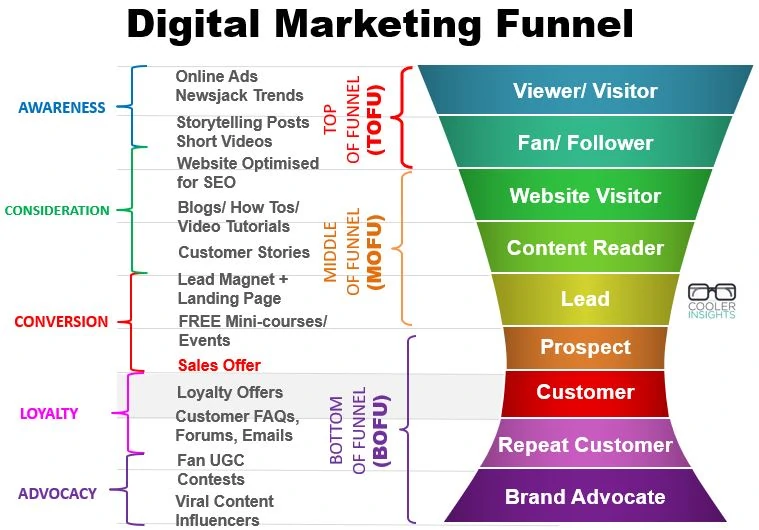
Detailed marketing funnel proposed by the company Cooler Insights:
How to build a sales funnel
In a comprehensive set of statistics compiled by an independent publication for content makers Ecommerce Bonsai, Among other things, it says that 90 per cent of users are not ready to buy a product after visiting the site for the first time. Moreover, the consulting company EmailToolTester, has determined that the number of customer interactions can vary from 1 to 50 depending on the industry and audience. This is why a well-designed sales funnel becomes a priority for marketers. The basic steps of building one:
- Establish goals and key metrics.
- Define the target audience and map out the customer journey from brand awareness to purchase and retention.
- Create content and offers for each stage.
- Set up conversion points and connect tools (lendings, CRM, email).
- Track key metrics and customer behaviour.
- Automate communications and lead warming.
- Test and improve the funnel based on results.
A detailed sales funnel should include information on the stages of customer touchpoints, targeted actions, channels and tools to be used to motivate users.
Examples of building marketing funnels
Funnel for e-commerce
The e-commerce marketing funnel focuses on a quick buying cycle and maximising conversions on the website. The main goal is to engage the user, convince them of the value of the product and encourage them to buy, then retain them through loyalty programmes and repeat sales.
| Stage | Customer action | Channels | Instruments | Metrics / KPIs |
| Awareness | Sees an advert or social media post | Instagram, Facebook, Google Ads | Targeted advertising, banners | Reach, CTR, number of unique visitors |
| Interest | Reviews products, reads reviews | Website, email | Lead magnets, mailings, recommendations | Number of pages viewed, CTR, % of subscriptions |
| Consideration | Compares items, adds to basket | Website, email | Chat with a consultant, product comparison | Adds to basket, clicks on CTA, % engaged |
| Decision | Placing an order | Website | Shopping cart, coupons, remarketing | % of completed orders, average cheque, revenue |
| Retention | Repeat purchases, newsletter subscription | Email, social media | Loyalty programmes, promotions, recommendations | % of repeat purchases, LTV, NPSTV, NPS |
Funnel for B2B service
The B2B funnel is longer and more complex as decisions are made by a group of individuals and require ROI evaluation. The main focus is on building trust through content, demos, case studies and personal consultations. More information on what a B2B sales funnel is and its specifics can be found in this article HubSpot, a leading inbound marketing company.
| Stage | Customer action | Channels | Instruments | Metrics / KPIs |
| Awareness | Learns about the service, reads articles | LinkedIn, blog, email | SEO, content marketing, LinkedIn advertising | Traffic, blog views, CTR of adverts |
| Interest | Downloads a case study or a guide | Website, email | Lead magnet, email nurture-chain | Number of leads, subscriptions, CTR of emails |
| Consideration | Requests a demo or consultation | Website, phone call, email | Webinars, ROI calculator, consultations | Demo requests, % of conversion to MQL, engagement |
| Decision | Service subscription or contract | CRM, email | Special offers, tripwire, personalised offers | % of conversion to sale, CAC, average cheque |
| Retention | Subscription renewal, upsale | Email, account manager | Automation, drip campaigns, upsell | % renewal, LTV, NPS, number of recommendations |
Content marketing funnel
The sales funnel example for content marketing focuses on creating value and trust through useful content. The goal is to engage audiences, build brand expertise, and gradually warm users up to a subscription or purchase.
| Stage | Customer action | Channels | Instruments | Metrics / KPIs |
| Awareness | Finds an article or video | Blog, social media, YouTube | SEO, SMM, video, infographics | Traffic, views, CTR, reach |
| Interest | Reads/views the material, signs off | Email, blog | Email newsletters, free materials, webinars | Subscriptions, email CTR, average time on page |
| Consideration | Studies cases, evaluates the product | Website, email | Detailed guides, checklists, consultations | Downloads of materials, consultation requests, CTRs |
| Decision | Subscription to a paid course/product | Website, email | Tripwire, promotions, personalised offers | % of conversion to purchase, revenue, average cheque |
| Retention | Continues to use, shares content | Email, social media | New content, mailing list, community, recommendations | % of repeat subscribers, LTV, engagement, NPS |
Evaluating the results of sales funnel implementation
Once the sales funnel has been implemented, it is important to regularly evaluate its effectiveness and make adjustments. The main goal is to understand how well customers are converting at each stage, where losses occur, and which tools work best:
- Traffic and Reach – how many potential customers learnt about your product.
- Conversion by stage – the percentage of customers moving from Awareness to Interest, Consideration and Decision.
- CPL / CAC – the cost to attract a lead or customer.
- AOV (average cheque) and LTV – how much a customer brings in on average and how long they stay with you.
- NPS and Satisfaction – how satisfied customers are with the product and are willing to recommend you to others.
- Retention / repeat purchases – a measure of retention and engagement.
Regular analysis of these metrics allows you to identify bottlenecks in the funnel, improve content and offerers, as well as increase overall conversion and efficiency of advertising investments.As you can see, building a sales funnel is a complex and time-consuming process that requires not only a deep understanding of the industry and audience, but also marketing tools. Art-Marks team manages to build a client’s path with careful elaboration of stages and adaptation to the client’s business. This is possible thanks to the experience of co-operation with companies from different spheres and the comprehensive use of digital promotion channels.
*** Translated with www.DeepL.com/Translator (free version) ***
