


Corporate identity and its importance in building a strong brand
Corporate identity includes all the characteristics of a company that make it unique – distinguish it from its competitors. Some business owners make the mistake of thinking that corporate identity is just a beautiful company logo that reflects the idea and values of the structure they have created. In reality, it is a strategic asset that influences audience trust, brand perception, memorability and financial success. Properly formed style defines the personality of the company. It helps to recognise it even without representatives. Just as a person’s style depends on shoes, clothes, hairstyle, make-up, manner of behaviour, so corporate style forms all significant characteristics of the brand, directed inwards and outwards.
What is corporate identity
The corporate identity of a modern company is a unique image, conditioned by a harmonious appearance and manner of communication, aimed at forming an unambiguous perception of the brand among the target audience. Among all the elements that help in positioning a business or a trade mark, visual elements are considered key for the consumer. They are placed on products, packaging, advertising materials to communicate with customers.
Important point: the terms “corporate identity” and “branding” are often used interchangeably. However, they are significantly different. Branding refers to the characteristics and focus of a specific product. Corporate identity is a more global concept. It reflects the characteristics and focus of the company that created the product.
Significance of corporate identity for a company
Identity is important both for start-ups and large corporations with a long and successful history. Work on a company’s corporate identity cannot be ignored. There is a popular expression among experts that explains the above. “Shape your identity, otherwise it will shape you”. This means that in the absence of directed actions on the part of company representatives to create a unique style, it will be built under the influence of external factors. The result in most cases turns out to be unsatisfactory, and the reputation of the business can suffer greatly, up to complete devaluation.
The importance of a strong, positive corporate identity can hardly be overestimated. Corporate identity directly affects the success of a business by shaping the mindset, influencing the decisions of potential customers. A strong and positive corporate identity helps position a company as more trustworthy. This is a very important point for market presence. According to research conducted by Deloitte Digital and Twilio, among consumers who track their purchases, 68% of respondents spend more on products from trusted brands. Statistically, it is corporations that are trusted by their customers that receive more sales, loyalty, positive feedback and recommendations.
Why you need a well-thought-out corporate identity for success
Corporate identity formation is important for:
- Strengthening brand reputation. Identity combined with excellent service increases customer trust and loyalty. Such companies rank high in the ratings of the target audience.
- Increased recognition. A corporate image clearly demonstrates a company’s promise and brand values. According to the Nielsen Global Survey, a result of a study of the automotive industry showed that up to 90% of consumers say that a corporation’s recognisability influences their decision to purchase its vehicle. At the same time, respondents expect consistency and a unified corporate voice across all channels and platforms.
- Differentiation. With a great corporate identity-focused marketing strategy, companies can differentiate themselves from the competition. According to Foundry12, using a corporate colour increases brand recognition by around 80%. Consumers make an almost instant decision to interact with a company’s content if it is visually recognisable and consistent with the style.
- Revenue growth. The consistency of the company and maintaining an excellent reputation has a positive impact on financial success. According to Lucidpress, this situation can lead to an increase in business revenue of up to 33%.
Understanding what corporate identity is and how important it is opens up prospects for a company to become recognisable in the market, outperforming hundreds of competitors. The right actions in its formation allow to save resources, and unification of visual materials turns the brand in the minds of consumers into a vivid memorable image.
Elements of corporate identity
What is included in the corporate identity – a question that worries the head of the company, if he understands the importance of forming an identity. In fact, its elements are selected individually, taking into account the specifics of the business and the owner’s preferences. In a general sense, the image of the company is formed by four main areas: corporate culture, behaviour, communications and design. Each of them includes quite a few elements, but we will consider only the main ones:
- Title. A successful one should be memorable and easy to pronounce. Important are also the semantic load and reflection of the essence of the business. When choosing a name should avoid slang words, names (to promote the cafe “Irina” will require more money than for a similar, but with a signboard “Sushi paddle”). But the abbreviations are perfectly perceived by the target audience. Great if it turns out to come up with a name with humour, the main thing that it does not cause negative associations.
- Slogan. Capacious, cute, catchy phrase increases recognisability. An important condition is the semantic load. Ideally, the slogan emphasises the advantages of the product, communicates the company’s philosophy or emphasises the benefits.
- Logo. A unique graphic image, symbol or emblem necessary to identify a business, its products and services. The best logo is simple, memorable, and necessarily unique. Large corporations often put a deeper meaning into a logo, reflecting their philosophy.
- Trademark. It is often confused with a logo. However, a trademark is a unique image, text, sound or word combination. It can be registered to become a legally protected piece of intellectual property.
- Mascot. In corporate identity is a mascot character. Its tasks are to personify the brand and create an emotional connection with the audience. It can be a person, an animal or a fantastic creature.
- Colour scheme. Its choice seems to be the simplest, but this opinion is wrong. In order for the brand colours to evoke positive emotions in consumers at an intuitive, deep level, it is necessary to know the preferences of the CA. In addition – take care of a pleasant compatibility of shades.
- Fonts. When choosing them in the priority is not uniqueness, but simplicity. It determines the ease of reading, which is extremely important for a positive perception of the brand by potential customers.
Understanding what is included in the corporate identity does not oblige you to develop all the elements immediately after the registration of the trade mark. Each of them requires attention and a balanced approach. Keep in mind: changing familiar identity elements can be a complicated process. Visually different products may be perceived by consumers as fake, which can lead to a drop in sales.
To avoid mistakes and unacceptable variants of using corporate identity elements, internal documents – brandbook and guideline – are provided. The first is an official instruction binding on employees, marketers and designers. The brandbook describes the concept of the brand and provides detailed guidance on the use of all its elements, including identity. Guideline is an official document containing a set of rules for the application of visual elements of the corporate tone. Its task is to ensure uniformity and integrity of brand perception across all media.
It may seem that these concepts – brandbook and guideline – are almost identical. However, they are not. A guideline is a technical guide to the use of corporate identity elements. A brandbook is a more extensive document. It includes, among other things, the guideline, but describes different aspects of the brand, including the mission, values, and strategy.
Creating a corporate identity: main priorities
The key objective of corporate tone is to make the brand unique, standing out among thousands of other companies. To achieve this goal, every element must be:
- original – completely different from other brands’ marks;
- recognisable – due to simple images and fonts, harmonious combination of colours;
- memorable – capacious and catchy;
- informative – containing valuable information about the company.
The professionals of the Art-Marks advertising agency know perfectly well how to create a corporate identity. We have dozens of successfully completed projects of different levels of complexity. Our priority is an individual approach and fulfilment of all tasks set by the customer. We will develop a corporate identity of the company, which will be an important factor for entering the top leaders of the segment.
Literature used:
- Corporate brand design: Developing and managing brand identity. [Electronic resource]./Mohammad Mahdi Foroudi, Pantea Foroudi// – Routledge-2021- p.115-121
- Logo: (Corporate Identity Book, a guide to branding for designers and design students)./Michael Evami//-Lawrence King-2016- p.211-215
It might also be interesting
See all




Marketing funnel: why businesses need it
In today’s business, when there are many tools to promote a product, marketing strategy becomes overgrown with details that are often difficult to link together. The sales funnel is a model of consumer interactions with a brand, from first encounter to repeat sales. It helps to understand what measures really bring results, where to improve the system and at what point potential customers are “lost”. However, it is only through a deep study of each stage that the full potential of this tool can be utilised.*** Translated with www.DeepL.com/Translator (free version) ***
What is a sales funnel and why to implement it
The marketing funnel allows you to visualise the “customer journey” not only in terms of one promotional channel, but of all interactions. This approach helps to track results at different stages and improve them. Valuable information that the model provides:
- the number of potential customers at each stage of interaction;
- conversion rate by stage – the percentage of people moving from one stage to another;
- “bottlenecks” in sales, where customers “drop out”;
- the effectiveness of each individual promotion channel and campaigns;
- which products, promotions or content are resonating;
- sales forecasting and growth potential based on current conversion rates;
- how many customers return and recommend the product to others;
- return on investment in advertising.
This data gives a clear picture of the customer journey, allows you to improve it and then already “lead” a potential customer with a pre-planned “route”.
The main stages of the marketing funnel
All modern interpretations of the sales funnel are based on the AIDA model, described by the pioneer of marketing – American advertiser Elias St. Elmo Lewis (Elias St. Elmo Lewis). Elias St. Elmo Lewis (Elias St. Elmo Lewis) in his publications in trade publications of the late XIX – early XX century. He was the first to formulate the sequence:
AIDA: Attention → Interest → Desire → Action
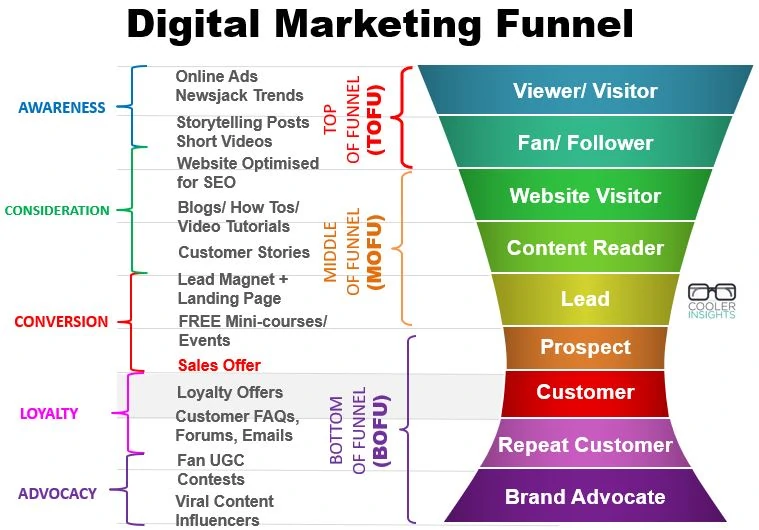
Today, marketers are also adding a fifth stage – loyalty. It has taken an important place in the sales funnel, because attracting new customers is much more expensive for a company than retaining them. So, what is the essence of each stage of interaction:
- Attention/awareness – determines the first contact, informs the audience about the existence of the brand.
- Interest/consideration – the company remains in the memory, and the user starts looking for more information about it.
- Desire – the visitor becomes a lead, a potential customer who already has an idea of how the brand can be useful to him.
- Conversion – the user performs the target action to which the funnel was leading, mainly a purchase.
- Loyalty – the customer makes repeat purchases, becomes loyal to the brand and recommends it to others.
Detailed marketing funnel proposed by the company Cooler Insights:
How to build a sales funnel
In a comprehensive set of statistics compiled by an independent publication for content makers Ecommerce Bonsai, Among other things, it says that 90 per cent of users are not ready to buy a product after visiting the site for the first time. Moreover, the consulting company EmailToolTester, has determined that the number of customer interactions can vary from 1 to 50 depending on the industry and audience. This is why a well-designed sales funnel becomes a priority for marketers. The basic steps of building one:
- Establish goals and key metrics.
- Define the target audience and map out the customer journey from brand awareness to purchase and retention.
- Create content and offers for each stage.
- Set up conversion points and connect tools (lendings, CRM, email).
- Track key metrics and customer behaviour.
- Automate communications and lead warming.
- Test and improve the funnel based on results.
A detailed sales funnel should include information on the stages of customer touchpoints, targeted actions, channels and tools to be used to motivate users.
Examples of building marketing funnels
Funnel for e-commerce
The e-commerce marketing funnel focuses on a quick buying cycle and maximising conversions on the website. The main goal is to engage the user, convince them of the value of the product and encourage them to buy, then retain them through loyalty programmes and repeat sales.
| Stage | Customer action | Channels | Instruments | Metrics / KPIs |
| Awareness | Sees an advert or social media post | Instagram, Facebook, Google Ads | Targeted advertising, banners | Reach, CTR, number of unique visitors |
| Interest | Reviews products, reads reviews | Website, email | Lead magnets, mailings, recommendations | Number of pages viewed, CTR, % of subscriptions |
| Consideration | Compares items, adds to basket | Website, email | Chat with a consultant, product comparison | Adds to basket, clicks on CTA, % engaged |
| Decision | Placing an order | Website | Shopping cart, coupons, remarketing | % of completed orders, average cheque, revenue |
| Retention | Repeat purchases, newsletter subscription | Email, social media | Loyalty programmes, promotions, recommendations | % of repeat purchases, LTV, NPSTV, NPS |
Funnel for B2B service
The B2B funnel is longer and more complex as decisions are made by a group of individuals and require ROI evaluation. The main focus is on building trust through content, demos, case studies and personal consultations. More information on what a B2B sales funnel is and its specifics can be found in this article HubSpot, a leading inbound marketing company.
| Stage | Customer action | Channels | Instruments | Metrics / KPIs |
| Awareness | Learns about the service, reads articles | LinkedIn, blog, email | SEO, content marketing, LinkedIn advertising | Traffic, blog views, CTR of adverts |
| Interest | Downloads a case study or a guide | Website, email | Lead magnet, email nurture-chain | Number of leads, subscriptions, CTR of emails |
| Consideration | Requests a demo or consultation | Website, phone call, email | Webinars, ROI calculator, consultations | Demo requests, % of conversion to MQL, engagement |
| Decision | Service subscription or contract | CRM, email | Special offers, tripwire, personalised offers | % of conversion to sale, CAC, average cheque |
| Retention | Subscription renewal, upsale | Email, account manager | Automation, drip campaigns, upsell | % renewal, LTV, NPS, number of recommendations |
Content marketing funnel
The sales funnel example for content marketing focuses on creating value and trust through useful content. The goal is to engage audiences, build brand expertise, and gradually warm users up to a subscription or purchase.
| Stage | Customer action | Channels | Instruments | Metrics / KPIs |
| Awareness | Finds an article or video | Blog, social media, YouTube | SEO, SMM, video, infographics | Traffic, views, CTR, reach |
| Interest | Reads/views the material, signs off | Email, blog | Email newsletters, free materials, webinars | Subscriptions, email CTR, average time on page |
| Consideration | Studies cases, evaluates the product | Website, email | Detailed guides, checklists, consultations | Downloads of materials, consultation requests, CTRs |
| Decision | Subscription to a paid course/product | Website, email | Tripwire, promotions, personalised offers | % of conversion to purchase, revenue, average cheque |
| Retention | Continues to use, shares content | Email, social media | New content, mailing list, community, recommendations | % of repeat subscribers, LTV, engagement, NPS |
Evaluating the results of sales funnel implementation
Once the sales funnel has been implemented, it is important to regularly evaluate its effectiveness and make adjustments. The main goal is to understand how well customers are converting at each stage, where losses occur, and which tools work best:
- Traffic and Reach – how many potential customers learnt about your product.
- Conversion by stage – the percentage of customers moving from Awareness to Interest, Consideration and Decision.
- CPL / CAC – the cost to attract a lead or customer.
- AOV (average cheque) and LTV – how much a customer brings in on average and how long they stay with you.
- NPS and Satisfaction – how satisfied customers are with the product and are willing to recommend you to others.
- Retention / repeat purchases – a measure of retention and engagement.
Regular analysis of these metrics allows you to identify bottlenecks in the funnel, improve content and offerers, as well as increase overall conversion and efficiency of advertising investments.As you can see, building a sales funnel is a complex and time-consuming process that requires not only a deep understanding of the industry and audience, but also marketing tools. Art-Marks team manages to build a client’s path with careful elaboration of stages and adaptation to the client’s business. This is possible thanks to the experience of co-operation with companies from different spheres and the comprehensive use of digital promotion channels.
*** Translated with www.DeepL.com/Translator (free version) ***
